
Kill the Clipboard, one year in.
A year after 60 companies pledged to kill the clipboard, the pipes are measurably better and the scoreboard is empty. What CMS published, what it has not — including how sixty percent was calculated — and why the harder problem starts after the record arrives.
On Monday, July 27, 2026, the Department of Health and Human Services and CMS held a one-year anniversary event for the Health Technology Ecosystem at HHS headquarters in Washington. A year earlier, at a White House event, more than 60 companies signed voluntary pledges. Among the commitments was one aimed squarely at a problem every patient recognizes. Under the initiative's Kill the Clipboard use case, EHR vendors committed to accept inbound patient data by QR code, Smart Health Card, or Smart Health Link using FHIR, and to hand a visit record back the same way at the end of the encounter, so that patients would stop having to recall and rewrite their own medical history at every front desk.
The shorthand for it was killing the clipboard.
I want to lay out what has actually happened since, because the honest version is more interesting than either the celebration or the eye roll.
What shipped
A fair amount, and more than we expected.
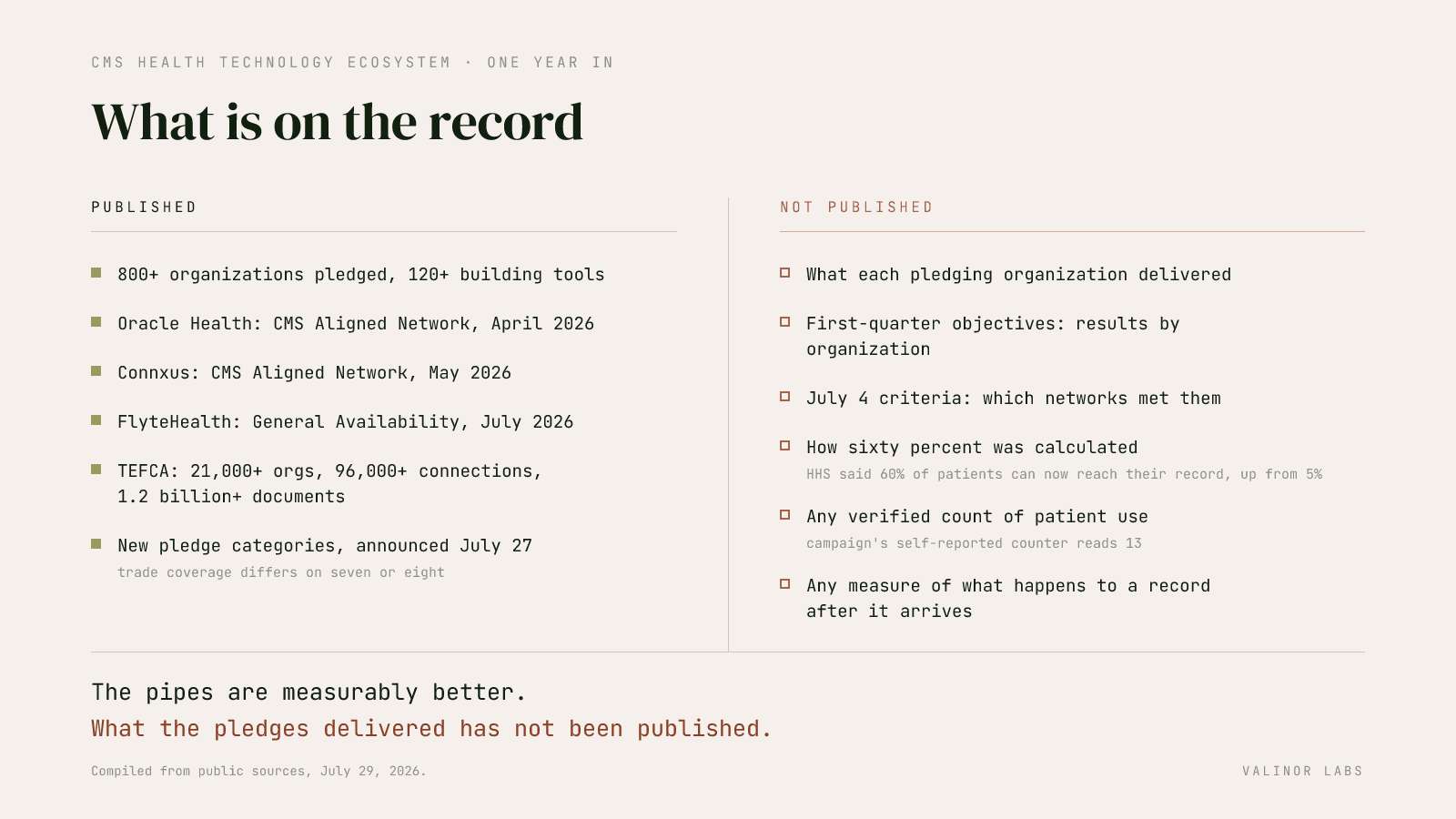
The pledge list grew, and kept growing. Roughly 60 organizations at the start. More than 700 by CMS's own account in April. More than 800 by the anniversary, now including the Social Security Administration, the Department of Veterans Affairs, and state health agencies. At the April launch, agency leadership said over 120 organizations had reported their products were ready for use or close to it.
That April event was itself a deliverable. CMS used it to launch the first wave of ecosystem tools, including a Medicare app library and an initial set of patient-facing applications, and dozens of tools were shown.
The designations became real rather than aspirational. Oracle Health announced CMS Aligned Network status in April, along with a check-in flow that lets a patient verify identity digitally and grant access to their records. Connxus announced the same designation in May, describing itself as the only health information exchange in Texas to hold it. At the anniversary event, companies were recognized for reaching General Availability, a designation indicating a solution has met the patient-facing requirements and is live for Medicare beneficiaries. FlyteHealth, one of the first, got there by earning DiMe certification under the CARIN Code of Conduct, implementing identity verification at the IAL2 assurance level, and enabling record retrieval from CMS Aligned Networks with no patient portal login required.
CMS also used the anniversary to widen the program rather than close it out, announcing new pledge categories covering price transparency, clinical trial matching, patient scheduling, pharmacy interoperability, population health data exchange through bulk FHIR, and real-time patient access to insurance benefit information, along with a work group on diagnostic imaging. Trade coverage of the same event differed on whether there were seven of them or eight. Either way, the agency is not treating year one as a finish line.
CMS was also candid about the parts that have not moved. Officials said some pledges showed meaningful traction, particularly around standards adoption and early interoperability pilots, while others lagged, with many commitments still in early implementation rather than fully deployed. That is a more honest self-assessment than these events usually produce, and it deserves saying.
Underneath all of it, the national exchange infrastructure grew substantially. In November, TEFCA reported roughly 10,600 live organizations, more than 60,000 connections, and about 115 million documents exchanged since December 2023. The current figures are more than 21,000 organizations, over 96,000 connections, and more than 1.2 billion documents. Organizations roughly doubled. Connections grew by about sixty percent. Document volume grew by an order of magnitude, which means the pipes that already existed are carrying far more traffic than they were nine months ago. That is noteworthy.
That is real work by real engineering teams, and anyone dismissing this initiative as theater is not reading the record.
What has not been published
Here is the gap.
CMS did publish something. The April launch produced an app library and a showcase, and that is a catalogue of products that exist. It is not an accounting of which of the pledging organizations met which commitment, and those are different questions. The second one is the question a clinic operator would ask, and I could not find an answer to it. Not for the first-quarter objectives, not for the July 4 criteria.
Then there is the number that got the most attention.
At the anniversary event, HHS chief counselor Chris Klomp said that sixty percent of patients in the United States can now access their own record in an app of their choice, up from five percent twelve months ago, and that he expects eighty percent by October.
I would like that to be true. If it is, it is the most important thing that happened in American health data this year, and it deserves a paper rather than a podium. Reporting from the event noted that the department did not explain how it arrived at the estimate. I could not find a published methodology either. Access measured how, at what point, for which populations, counted against what denominator. Those are not pedantic questions. A twelvefold change in a single year is either a genuine triumph or a definitional artifact, and the thing that separates those two is a methodology note.
The consumer-facing campaign, meanwhile, built a public counter at killtheclipboard.com. Patients who share records digitally instead of filling out paper are invited to report it, and the total is displayed. On July 29 it read 13, against a stated goal of 1,000. That figure deserves its caveat in the same breath. It is self-reported, it requires a patient to use the tool and then separately fill out a form saying they did, and actual usage is presumably higher. It is a campaign engagement mechanic, not an adoption metric, and I am not going to treat it as one.
It is a fair measure of how carefully the site is maintained, though. The clipboard funeral it promised for July 4 did happen, three weeks late, complete with a coffin and a jazz band, at the anniversary event. On July 29 the site still described it as upcoming.
I am not the only one who went looking. Two trade publications covering the same event reported that officials offered few substantive updates on the federal tools CMS had promised to build, and that the new imaging work group was announced without a stated outcome.
Which leaves the question that matters untouched. Not how many products exist. Not what a campaign site says. What the more than 800 pledging organizations delivered against what they signed, and how sixty percent was calculated. Neither has been published.
Why a voluntary framework produces this pattern
The CMS Interoperability Framework is not a regulation, and CMS says so itself: a voluntary blueprint for modern health data exchange, not intended to create new regulatory burdens. The Framework carries no mandate, no civil monetary penalty, and no compliance deadline. The first quarter of 2026 was framed as a period in which early adopters would aim to showcase objectives, softer even than a target date. The July 4, 2026, criteria, including FHIR API access, clinical documents returned as FHIR attachments, encounter notifications, and a record locator service, remain part of that same voluntary structure.
Be careful what that does and does not mean. It is a statement about the Framework, not about the field. Information blocking penalties are not voluntary. HIPAA's right of access is not voluntary. The Interoperability and Prior Authorization rule is not voluntary for the payers it binds. CMS is explicit that the Framework does not contravene, supersede, or preempt any of it. If you are a provider reading this, nothing here says your obligations got lighter.
CMS is also explicit about how the central designation works. In the agency's own words, networks self-attest that they meet the interoperability criteria and agree to be reviewed if they are suspected of not meeting them. The review is no walk in the park. A category requires the full criteria list, and patient-facing apps must submit to CMS review including disclosure of data sources and a security checklist.
And self-attestation is not a scandal. It is a deliberate and defensible design choice. Attestation regimes move faster than certification regimes, and speed was the entire point. Waiting for a rule with an enforcement arm behind it would have cost years, and the industry does not have years. I believe that is the correct approach.
What attestation cannot do is tell you how much of the promised capability is live for an actual patient standing at an actual front desk. It tells you what an organization asserts about itself. Those are different questions, and only one of them has a published answer right now.
The harder problem underneath
Set aside the designations for a moment.
Suppose all of it works perfectly. A patient walks in, scans a QR code, and a complete FHIR bundle lands in the practice's system in under a second. Every network is aligned, every identity is verified, every API responds.
The clinician now has fifteen minutes and a pile of records from four organizations that have never agreed on how to describe the same patient. The same medication under two names at two strengths. A problem list that contradicts itself across sources. A discontinuation recorded in one system and absent from three. Nothing in that bundle tells anyone which version is current.
Getting the record to arrive and knowing what the record says are separate problems. The last year made genuine progress on the first one. The second problem is not solved by a faster pipe, and it will not show up on any scoreboard, because there is no metric for a clinician who received everything and still could not tell what was true.
That is the work we think matters now, and it is why we are building what we are building.
What I am watching, and you should too
Whether CMS publishes an accounting of what the first-quarter and July commitments actually delivered, at the level of individual pledging organizations. Whether the methodology behind the sixty percent figure gets published before the eighty percent figure arrives in October. Whether General Availability designations keep accumulating or stall once the anniversary news cycle passes. Whether the new pledge categories draw real builders or mostly signatures. And whether anyone starts measuring what happens to a record after it arrives, rather than only whether it moved.
The pipes are better than they were a year ago. That is worth saying plainly. It is also not the same thing as a doctor knowing what you take.
Sources
CMS program documentation. CMS, “Health Technology Ecosystem,” cms.gov, including the overview page describing the voluntary framework, the early adopters pages describing the Kill the Clipboard use case, the categories page describing self-attestation and review, and the Interoperability Framework page describing the July 4, 2026 criteria. Accessed July 2026.
CMS, “CMS Launches First Wave of HealthTech Ecosystem Tools, Fast-Tracking a Fully Digital, Patient-Centered Health System,” press release, April 9, 2026. Source for the pledge count above 700 and for the Medicare app library and first-wave patient-facing applications.
Healthcare Dive, coverage of the CMS HealthTech Ecosystem Live First Wave Launch event, April 9, 2026. Source for the statement that over 120 organizations reported their products ready for use or close to completion.
Nextgov/FCW, coverage of the July 27, 2026 anniversary event. Source for the pledge count above 800, the sixty percent statement and the absence of a published methodology, and the report that officials gave few substantive updates on promised federal tools.
Becker's Hospital Review, coverage of the July 27, 2026 anniversary event. Corroborates the pledge count, the sixty and eighty percent figures, and the new pledge categories.
STAT News, coverage of the July 27, 2026 anniversary event, including the description of the clipboard funeral.
Health IT Answers, coverage of the July 27, 2026 anniversary event. Source for the CMS self-assessment that some commitments remain in early implementation rather than fully deployed.
Wilson Sonsini, client alert on the CMS Interoperability Framework, August 2025. Independent legal reading of the July 4, 2026 criteria.
Company announcements, each describing its own work. Oracle Health, CMS Aligned Network status, April 20, 2026. Connxus, CMS Aligned Data Network selection, May 2026. FlyteHealth, General Availability announcement, July 28, 2026.
The Sequoia Project, TEFCA Recognized Coordinating Entity, rce.sequoiaproject.org. Current figures accessed July 2026; November 2025 baseline from the RCE's December 2025 update. The growth comparisons above are arithmetic on those two published figures.
killtheclipboard.com, accessed July 29, 2026. The counter figure is self-reported by patients through a form on that site and is described as such above.
Rayman Khan is Co-founder and Chief Legal Officer of Valinor Labs. This post is general commentary on public policy, not legal advice, and does not create an attorney-client relationship.
The intelligence layer for healthcare data.
Unify the scattered records, surface what matters, and build better care experiences on top of truly interoperable infrastructure.
Partner with us